
ORIGINALLY PUBLISHED AT KLEZMERSHACK.COM SUNDAY, TUESDAY, NOVEMBER 2, 2004
BY STEWART I. CHERLIN
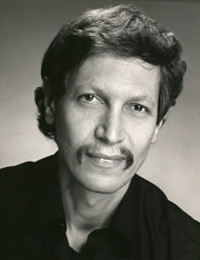
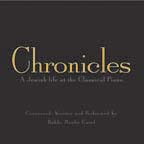 Chronicles is unlike any other performance work, sermon or lecture. Moshe Cotel draws you into his lessons as a masterful storyteller and artist. His presentation is humorous and uplifting. The companion piece to each lesson serves as a reflective pond that embellishes the meaning of the lesson. The music content mirrors each lesson. The accompanying piece is not an afterthought but is equal and integral to the lesson.Subsequent to recounting the merits of Noah’s life Cotel plays a pristine piano piece by a very young W.A. Mozart. Torah teaches that Noah was faultless in his generation. The rabbis differ as to the meaning of the passage. Mozart, in Cotel’s estimation was “not just faultless in his own generation, he was faultless for all generations.” The Allegro in Bb, KV3 is a faultless gem of simplicity, balance and innate charm. Will our generation merit another Mozart or Noah?Another selection highlights the confluence of two men named Bach. A Prelude and Fugue from theWell-Tempered Clavier by J.S. Bach is paired the rabbinic commentator Rabbi Joel Sirkes, 1561–1640, one of the greatest talmudic scholars of Poland, known by the acronym BaCH (abbreviation for Bayit CHadash, his talmudic commentary). As Cotel quips, he was “the Jewish Bach.” Here the student at the piano bench and his counterpart at the tisch (table) in the Beis Midrash (house of study) converge. The great Lutheran composer and the Talmudic commentator share common ground.
Cotel relates that playing Bach is his “daily vitamin B”. Likewise, it is a Jewish custom to read a daf(page) of Talmud each day. This custom unites Jews throughout the world as they study the same text; are literally on the same page. Similarly, playing Bach preludes and fugues sharpen an artist’s musical sensibility as well as one’s technical proficiency. Bach in the hands of Moshe Cotel reveals his discipline and sensibility to the literature.
In the section titled Arnold Schoenberg, Crossing Broadway at 122nd Street Cotel asks us to consider that “the meeting of rabbi and artist is not dissimilar from the confrontation of priest and prophet.” Moses und Aron, Arnold Schoenberg’s uncompleted masterwork expresses this central conflict. Moses the prophet is unyielding in his spiritual actions. Aaron the priest out of love of his people assists with the sin of molding the golden calf. Moses speaks to God, Aaron to the people. Cotel asserts, “Like Moses, Schoenberg followed his internal vision without compromise.”
There is no room for compromise in Schoenberg’s “wilderness of atonality”. We hear this expressed in a selection from Three Piano Pieces, Opus 11 composed in 1909. Schoenberg as Moses explored an uncharted wilderness, one that would transform everything in its wake. The wilderness is critical in each man’s journeys.
Chronicles also features the Prelude for Left Hand, Op. 9, No. 1 by the composer and mystic Alexander Scriabin. The accompanying lesson is on the commandment to bind tefillin shel yad (the hand phylactery) upon the left hand. Often in piano music the left hand provides the foundation for a piece. It is the strength of the music. Scriabin composed several pieces for left hand alone due to an injury to his right hand. The works rely on a technique that incorporates melody and accompaniment in one hand. Torah tells us to “bind these words on your hand” (Deut 6:8). This is understood to mean upon your left hand, upon your left hand alone. Cotel masterfully plays the challenging work illustrating the strength in the left hand alone.
Chronicles includes several additional works with matching commentary. Noteworthy is a prize winning composition, Piece for Piano, 4-Paws by Ketzel the Cotel family cat. On music paper, Moshe transcribed Ketzel’s feline saunter down the piano keyboard one morning. The piece received Special Mention in the 1997 Paris New Music Review’s “Sixty Seconds for Piano,” an international competition for original piano miniatures. This reflects the spirit of the Jewish concept of kavannah, which translates as deep concentration or intention. Through kavannah one can experience moments of inspiration. During worship kavannah raises us to a higher state; it brings us closer to God. Chronicles achieves the spirit of kavannah.
Chronicles is a work that you will want to add to your music collection as well as your general library. Chronicles inspire; the performance is exquisite. It is a work that reveals deeper and deeper meaning upon each listening.
Moshe Cotel has started work on a follow up volume and hints that it will be appropriately namedChronicles II. This will be a welcome addition to Rabbi Cotel’s oeuvre.
Other music compositions by Moshe Morris Cotel featuring Jewish themes include: Dreyfus, Opera in Two Acts (1980–83), The Fire and the Mountains for Chorus, Children’s Chorus, Soloists and Percussion (1977), August 12, 1952: The Night of the Murdered Poets for Narrator and Chamber Ensemble (1978), as well as many other works.